WO-018 · work order · 2026-10-08
German chamomile
Matricaria chamomilla
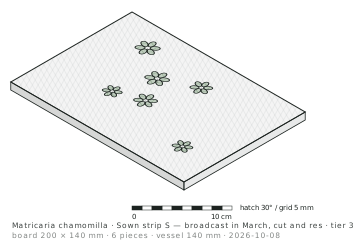
Chamomile is the plant where the difference between the wild version and the tea bag is greatest. Fresh chamomile flowers steeped at 80 °C have a warm, apple-and-honey character that has nothing to do with the dusty yellow powder in a supermarket sachet, and the flowers themselves are a genuinely useful culinary ingredient in custards and syrups, not just in a cup.
Flower
chilled 3 daysConical yellow centre hollow when sliced; petals reflexed back and the head dry.
- 1
Drying — 35 °C, 3 h
Mesh tray in a single loose layer ≤ 2 cm deep, 1–2 m/s airflow - 2
Lactic fermentation — in a mead, 14 days
1 L wide-mouth jar, smaller jar as weight, 2 cm headspace, plate underneath - 3
Oil and vinegar infusion — 8 g in 400 mL milk, 20 min at 80 °C
Dark narrow-neck bottle; candy thermometer for the 60 °C ceiling - 4
Candying and sugar preservation — syrup 40 g : 500 mL, held at 80 °C
Jam thermometer to 110 °C, wire rack over a tray for 24–48 h of drying
| Operation | Parameter · duration |
|---|---|
| Harvest cue | Conical yellow centre hollow when sliced; petals reflexed back and the head dry. |
| Blanch | not required — used raw |
| De-bitter | None. Never pour boiling water — 80 °C preserves the apple note. |
| Chilled | 3 days |
Chamomile versus the look-alikes, and the hollow test
The German chamomile you want has a conical yellow centre that is hollow inside — cut the flower head vertically with a fingernail and you can see the cavity. That hollow receptacle is the definitive test and it separates it from the two common look-alikes: scentless mayweed, whose centre is solid, and corn chamomile, whose centre is also solid and whose white petals are broader and more overlapping.
The second test is smell. Crush a flower head: German chamomile is sweet, warm and unmistakably apple-like. Scentless mayweed smells of almost nothing, which is where its name comes from. If you have the hollow centre and the apple smell, you have the right plant.
A note on the third look-alike: stinking chamomile (Anthemis cotula) has a solid centre and smells unpleasant. If a daisy-ish plant in a field margin smells wrong, it is wrong.
Steeping it properly, at 80 °C
Boiling water destroys the volatile oils that make chamomile worth having — the same oils that are the whole point of the plant. Pour water that has been off the boil for about ninety seconds, or use a thermometer and stop at 80 °C, over 2 g of fresh flowers per 200 mL, and steep covered for four minutes. A saucer on top of the cup matters more than it sounds: the active compounds are volatile and an open cup loses them to the room.
Dried flowers need slightly more, about 2.5 g per 200 mL and five minutes, because the cell structure has to rehydrate before the oils come out. If your tea is bitter, you have either used boiling water or steeped for too long — chamomile does not get stronger in a good way after about six minutes.
The traditional use that is worth keeping is as a digestive after a heavy meal, and the evidence for chamomile as a mild carminative and relaxant is reasonable rather than strong. This is field information, not medical advice, and a tea is not a treatment for a medical condition.
In the kitchen, beyond the cup
Chamomile works in custard and this is the use that surprises people. Infuse 8 g of dried flowers in 400 mL of hot milk for 20 minutes, strain, and use the milk for a crème anglaise or a panna cotta. The apple note reads as vanilla-adjacent and the custard ends up tasting of something nobody can immediately place.
A syrup is the most useful form: 40 g of dried flowers, 500 mL of water, 400 g of sugar, brought to 80 °C and held for 20 minutes without boiling, then strained. It keeps six months in the fridge and goes into a gin sour, over a fruit salad, or into sparkling water. Freeze it in ice cube trays and you have chamomile ice for a summer drink.
Dried chamomile is also one of the better things to put in a sleep pillow, along with hops and lavender, and it is the only one of the three that is pleasant enough to use on its own if the others are not to hand.
Identification note: Only German chamomile has the hollow conical receptacle and the apple smell. Do not use stinking chamomile or scentless mayweed. Chamomile is in the Asteraceae family and can cause reactions in people with a ragweed or daisy allergy.