The part is the method
A plant is not one food. It is seven or eight different foods sharing a root system, and each of them wants a different hand. Nettle leaf is a spinach substitute in April and a mouthful of grit in August. Elder flower is a cordial; elder berry is a poison that has to be cooked out of itself. Burdock root is a vegetable; burdock leaf is a bitter wrap that most people spit out.
This bench is organised that way — by part first, then by plant. Every entry gives you the harvest window for that part, the signal that says it is ready, the numbered method that makes it edible, the parameters that method needs (numbers, temperatures, ratios, durations) and the storage life you get at the end of it.
How to read an entry
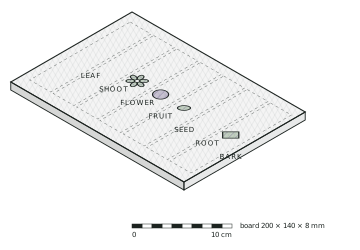
Each entry opens with a seven-cell part gauge. Cells in board green are parts of that plant worth harvesting; greyed cells are parts that are not worth the trouble, or not safe, and the entry will say which. Underneath, every usable part gets its own work block with a harvest window, a harvest signal, numbered process steps, a de-bittering parameter table and a storage figure.
The parameters are the point. “Blanch the greens” is not a recipe. “Blanch 90 seconds in unsalted water, then shock in ice water for the same 90 seconds” is a recipe, and 90 is the number that decides whether you get lunch or a bowl of chlorophyll mush.
What this site is not
This is not a foraging safety course and it is not a substitute for one. Plant identification is on you, and the parts of a plant that are edible and the parts that are not vary within the same species depending on age, soil and season. Several entries here describe plants with toxic lookalikes. Read the identification note at the foot of every entry before you pick anything, and if you are not certain of the identification, do not eat it.
| Plant | Part | Methods | Time | Yield |
|---|---|---|---|---|
| Stinging nettle Urtica dioica | Leaf | Blanching · Salt-brine pickling · Drying · Lactic fermentation · Oil and vinegar infusion | 45 s | ×0.72 |
Three-step summarySnap the petiole at the third node: a clean break with clear sap means tender. Blanch 45 s in salted water, ice-shock, then press — no soaking needed. 200 g raw leaf → 145 g blanched and pressed (×0.72). 500 g raw seed heads → 55 g cleaned seed (×0.11). | ||||
| Dandelion Taraxacum officinale agg. | Leaf | Blanching · Salt-brine pickling · Drying · Lactic fermentation | 90 s | ×0.64 |
Three-step summaryCentre-of-crown leaves under 12 cm, in April or September only. Two rounds: 90 s salted water, then 60 s fresh water; taste between rounds. 1 kg of crowns → 640 g trimmed leaf (×0.64). Root: 500 g lifted → 310 g scrubbed slices → 105 g roasted (×0.21 of the lifted weight). | ||||
| Plant | Part | Methods | Time | Yield |
|---|---|---|---|---|
| Ground elder Aegopodium podagraria | Shoot | Blanching · Salt-brine pickling · Drying · Lactic fermentation · Oil and vinegar infusion | 20 s | ×0.84 |
Three-step summaryTop leaflet pair must still be pressed shut; stem bends double without cracking. None needed in weeks 1–2; blanch 60 s if picked in week 3. 500 g raw shoots → 420 g trimmed and rinsed (×0.84); → 380 g jarred ferment after packing (×0.76). | ||||
| Japanese knotweed Fallopia japonica | Shoot | Blanching · Salt-brine pickling · Lactic fermentation · Candying and sugar preservation | 90 s | ×0.72 |
Three-step summaryBetween 20 cm and 1 m; the stem must snap like a runner bean with a wet, solid core. Blanch 90 s in salted water; discard the water, it carries most of the oxalate. 1 kg unpeeled shoots → 720 g peeled (×0.72). For the tart, 400 g peeled fills a 23 cm case. | ||||
| Plant | Part | Methods | Time | Yield |
|---|---|---|---|---|
| Elder Sambucus nigra | Flower | Drying · Lactic fermentation · Oil and vinegar infusion · Candying and sugar preservation | no heat | ×2.6 |
Three-step summaryUmbels fully open, dry, and the florets release with a light pull. None for syrup. For fritters, dust and fry in a 180 °C batter without any pre-treatment. 30 umbels (about 240 g of floret) → 2.6 L of cordial at 1:4 dilution. 1 kg berries → 620 mL juice → 3 jars of jelly. | ||||
| Plant | Part | Methods | Time | Yield |
|---|---|---|---|---|
| Bramble / blackberry Rubus fruticosus agg. | Fruit | Drying · Lactic fermentation · Oil and vinegar infusion · Candying and sugar preservation | no heat | ×0.9 |
Three-step summaryThe berry drops into your hand with no pull and leaves the white core behind. None. Under-ripe fruit is the only bitterness — wait six more days. 1 kg picked fruit → 900 g after removing leaves and under-ripe berries (×0.9). Jelly: 1 kg → 620 mL juice → 2.5 jars. | ||||
| Dog rose Rosa canina | Fruit | Drying · Lactic fermentation · Oil and vinegar infusion · Candying and sugar preservation | no heat | ×1.5 |
Three-step summaryHips give slightly under a thumbnail and the skin is glossy red with no black spot. Frost or 48 h freezing cuts the astringency; never blend whole, the hairs irritate the throat. 500 g whole hips → 700 mL of strained liquid → 1.5 L of syrup at 1:1 with sugar. 1 kg hips de-seeded by hand → about 300 g flesh. | ||||
| Plant | Part | Methods | Time | Yield |
|---|---|---|---|---|
| Hazel Corylus avellana | Seed | Drying · Oil and vinegar infusion · Candying and sugar preservation | no heat | ×0.48 |
Three-step summaryHusk straw-coloured and the nut rattles inside it; kernel pale cream and snaps. None. Two weeks of air-drying removes the astringency in the skin. 1 kg of nuts in husk → 480 g in shell (×0.48) → 210 g kernel (×0.21 of the original). | ||||
| Plant | Part | Methods | Time | Yield |
|---|---|---|---|---|
| Greater burdock Arctium lappa | Root | Blanching · Salt-brine pickling · Drying · Lactic fermentation · Oil and vinegar infusion | no heat | ×0.78 |
Three-step summaryFirst-year rosette: no stem at all, leaves flat to the ground from a single crown. Drop 3 mm slices into water with 1 tbsp vinegar per litre; never peel, only scrub. 1 kg lifted root → 780 g after scrubbing and trimming the crown (×0.78). Roasting to a brew: 400 g raw slices → 96 g dried (×0.24). | ||||
| Plant | Part | Methods | Time | Yield |
|---|---|---|---|---|
| Pedunculate oak Quercus robur | Bark | Drying · Lactic fermentation · Oil and vinegar infusion | no heat | ×0.42 |
Three-step summaryInner bark slips in whole sheets from fallen timber while the sap is up. None. Air-dry flat under weight 5 days; the astringency is the product. 1 kg of fresh inner bark → 420 g dried strips (×0.42). 1 kg of acorns in shell → 620 g kernels → 520 g leached meal. | ||||