WO-026 · work order · 2026-11-01
Beech
Fagus sylvatica
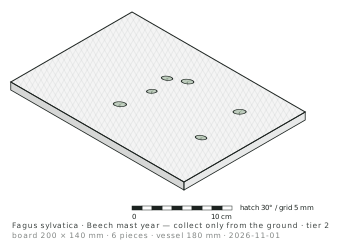
Beech mast is the most labour-intensive food on this site and the one that most repays understanding before you start. The seeds are small, triangular and fiddly, they come in quantity only every four or five years, and they are mildly toxic raw. They are also genuinely good — a sweet, oily nut that is closer to a pine nut than to a hazelnut — and beechnut oil was a real commercial product in Europe until the twentieth century.
Seed
chilled 180 daysRich chestnut brown and heavy; pale or wrinkled nuts float and are empty.
- 1
Blanching — roast 15 min at 150 °C
28 cm wide stainless pan, spider, ice bath at 1:1 - 2
Drying — 45 °C, 8 h
Mesh tray in a single loose layer ≤ 2 cm deep, 1–2 m/s airflow - 3
Oil and vinegar infusion — cold-pressed oil, 1 kg → 400 mL
Dark narrow-neck bottle; candy thermometer for the 60 °C ceiling - 4
Candying and sugar preservation — praline, ground with sugar
Jam thermometer to 110 °C, wire rack over a tray for 24–48 h of drying
| Operation | Parameter · duration |
|---|---|
| Harvest cue | Rich chestnut brown and heavy; pale or wrinkled nuts float and are empty. |
| Blanch | not required — used raw |
| De-bitter | Roast 15 min at 150 °C then rub the seed coats off — this addresses both flavour and toxicity. |
| Chilled | 180 days |
Leaf
chilled 1 daysThe first ten days after bud break, while the leaves are still silky.
| Operation | Parameter · duration |
|---|---|
| Harvest cue | The first ten days after bud break, while the leaves are still silky. |
| Blanch | not required — used raw |
| De-bitter | None in the first two weeks; after that the tannin rises fast. |
| Chilled | 1 days |
Mast years, and why you should not bother otherwise
Beech produces a heavy crop roughly every four to five years, with light or no crops in between. A mast year is unmistakable: the ground under the trees is carpeted with husks and the four-sided husks have split open to release the nuts. In a non-mast year you might find a hundred nuts in an afternoon; in a mast year, five kilos in an hour.
Collect from the ground, not from the tree. The nuts that are still in the tree are not ripe, and shaking a beech is both ineffective and pointless when there is a carpet underneath. Take them from the leaf litter, and expect to spend as long again on the cleaning.
The nuts should be a rich chestnut brown and heavy for their size. Pale, light or wrinkled ones are empty and will float in water — a quick water test sorts the crop in two minutes and is worth doing before anything else.
The toxicity question, answered honestly
Beechnuts contain a group of compounds called fagin and, in the seed coat, small amounts of a convulsant alkaloid. The practical picture: eating a handful raw is not harmful for most adults, but eating a large quantity raw — especially on an empty stomach — can cause nausea, stomach pain and in rare cases more serious neurological symptoms. Children are more susceptible than adults.
The traditional European handling was always to roast them. Roasting at 150 °C for 15 minutes and then rubbing off the brown seed coat reduces the problematic compounds substantially and improves the flavour, and it is what every historical source describes. Do not eat beechnuts raw in quantity, and do not give them to children at all.
The seed coat is the part that carries most of the alkaloid. Cooking the kernels in several changes of water, or roasting and then rubbing the coats off with a cloth, addresses the issue directly. Hulling beechnuts is slow — about 200 g of kernels an hour by hand — which is another reason to think of them as a small luxury rather than a staple.
What to do with a kilo of kernels
The most efficient use is oil, which is the traditional one and which concentrates the flavour. 1 kg of kernels cold-pressed gives around 400 mL of pale, sweet oil that is good on salads and excellent on fish, and it goes rancid within a year. You can also make a passable oil by warming crushed kernels at 60 °C and pressing them in a cloth, though the yield is lower.
Roasted and salted, beechnuts are simply a good bar snack and are best eaten within a few weeks. Roasted and ground, they substitute for hazelnut in a praline or in a pastry filling; the flavour is lighter and slightly more resinous than hazelnut and it works well with apple and with honey.
The young leaves in May are the other crop and a much easier one. They appear as a soft, pale, silky fringe for about ten days and are edible raw in a salad — mild, slightly sour and pleasant. Take the first two weeks only; after that the leaves harden and contain more tannin. Do not take more than a few leaves per branch, because the tree needs them.
Identification note: Beechnuts are mildly toxic raw in quantity — nausea, stomach pain and, rarely, neurological symptoms, with children more susceptible. Always roast 15 minutes at 150 °C and remove the seed coat. Do not eat them raw in quantity and do not give them to children.