WO-014 · work order · 2026-09-26
Watercress
Nasturtium officinale
Watercress is the best-tasting thing on this list and also the one with the most serious health caveat, so the caveat goes first: watercress growing in water that has been in contact with livestock, with human sewage, or with runoff from a field where animals graze can carry liver fluke (Fasciola hepatica). That is a real parasite, not a stomach upset, and it is the reason watercress is the one plant here that should be cooked unless you are certain of the water.
Leaf
chilled 3 daysTips floating flat downstream, stems hollow and grooved, water clear to the bed.
- 1
Blanching — 20 s for safety
28 cm wide stainless pan, spider, ice bath at 1:1 - 2
Salt-brine pickling — 2.5 % brine, 7 days
1 L wide-mouth jar, glass weight, 3 cm headspace - 3
Lactic fermentation — 2 % salt, 5 days
1 L wide-mouth jar, smaller jar as weight, 2 cm headspace, plate underneath - 4
Oil and vinegar infusion — blanched in oil 1:4, 14 days, chilled
Dark narrow-neck bottle; candy thermometer for the 60 °C ceiling
| Operation | Parameter · duration |
|---|---|
| Harvest cue | Tips floating flat downstream, stems hollow and grooved, water clear to the bed. |
| Blanch | 20 s |
| De-bitter | No bitterness to remove; blanch 20 s for parasite safety, not flavour. |
| Chilled | 3 days |
Shoot
chilled 3 daysTop 10 cm of a floating tip, snapping crisply at the cut.
- 1
Blanching — 15 s
28 cm wide stainless pan, spider, ice bath at 1:1 - 2
Salt-brine pickling — 2.5 % brine, 7 days
1 L wide-mouth jar, glass weight, 3 cm headspace - 3
Lactic fermentation — 2 % salt, 5 days
1 L wide-mouth jar, smaller jar as weight, 2 cm headspace, plate underneath
| Operation | Parameter · duration |
|---|---|
| Harvest cue | Top 10 cm of a floating tip, snapping crisply at the cut. |
| Blanch | 15 s |
| De-bitter | None; the shoot is milder than the leaf. |
| Chilled | 3 days |
Flower
chilled 2 daysSmall white clusters on upright stems from June.
- 1
Salt-brine pickling — 3 % brine, 14 days
1 L wide-mouth jar, glass weight, 3 cm headspace - 2
Oil and vinegar infusion — in vinegar, 21 days
Dark narrow-neck bottle; candy thermometer for the 60 °C ceiling
| Operation | Parameter · duration |
|---|---|
| Harvest cue | Small white clusters on upright stems from June. |
| Blanch | not required — used raw |
| De-bitter | None. Eat raw or scatter over a finished dish. |
| Chilled | 2 days |
Reading a stream before you pick from it
The conditions that make good watercress are narrow. You want moving water — a chalk stream with visible flow and a gravel bed — that is clear enough to see the bottom, has no smell, and has no livestock upstream within at least a kilometre. If you can see cattle in the field the stream runs through, or if the water is holding a scum, walk away. Surface water that has crossed a grazed field is the main route for liver fluke cysts.
Downstream of sewage works, in water that has been dredged or where the flow has been cut, and in any stream in a valley with intensive dairy, do not pick at all. Also avoid watercress growing below a road outfall or in water that smells of detergent, even if it looks clear.
The plant itself is easy: pinnate leaves with three to seven rounded leaflets, a hollow grooved stem, and a peppery taste. It roots at the nodes along the water surface and the tips float flat downstream. If it is growing in a static pond or in mud, it is not watercress — most likely it is one of the bittercresses, which are edible but far hotter.
Cooking it, which is not a compromise
Blanch watercress for 20 seconds in salted boiling water and it holds its pepper and most of its colour. Liver fluke metacercariae are killed at 60 °C in a few seconds, so 20 seconds in boiling water is comfortably past the safety line. What you lose is the crunch, and what you keep is the flavour — which is why cress soup made with blanched leaf and finished with a spoonful of raw, finely chopped leaf on top is the standard solution and a genuinely better dish than either version alone.
The half-and-half approach works for almost everything: blanch the bulk for body, add a handful of raw at the end for the top note. Use it in a sauce for fish, folded through mashed potato, or as the green in a velouté.
If you are certain about the water — your own spring, a stream with no livestock in its whole catchment, or a known-clean commercial source — then raw is fine and better. That is a judgement you have to make on site, not one this page can make for you.
The crop that keeps giving
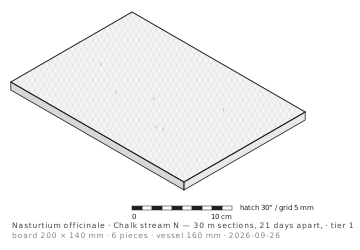
Watercress is one of the few plants here that can be cut repeatedly. Cut the top 10 cm of a floating tip and it branches below the cut and regrows in about 18–21 days through the growing season. Working a stream in sections, 30 m at a time, three weeks apart, gives a continuous supply from April to October without ever stripping a stretch.
The tips keep poorly — 24 hours in a bag and they yellow at the cut end. Stand them in a glass of cold water in the fridge, stems down, and they will hold three days. For storage beyond that, blanch 20 seconds, squeeze dry in a cloth, and freeze in 100 g portions; the pepper survives freezing far better than most people expect.
The flowers are edible and mild, and the seed pods that follow in late summer are the same hot, peppery thing in a different shape — a green seed pod picked in September has more heat than the leaf. Keep a few on the windowsill in a jar of water and they will keep producing tips for a fortnight.
Identification note: Watercress can carry liver fluke (Fasciola hepatica) when it grows in water that has been in contact with livestock or sewage. Only eat it raw if you know the whole catchment is clean; otherwise blanch 20 seconds, which is comfortably sufficient.