WO-007 · work order · 2026-08-28
Bramble / blackberry
Rubus fruticosus agg.
Blackberry is the most-picked wild fruit in Britain and the most commonly picked badly. The picker’s error is colour: a blackberry turns black roughly six days before it becomes sweet, and the difference between the two is the difference between a bowl of fruit and a bowl of tannin. Learning to test rather than to look is the entire skill.
Fruit
chilled 2 daysThe berry drops into your hand with no pull and leaves the white core behind.
- 1
Drying — fruit leather at 55 °C, 10 h
Mesh tray in a single loose layer ≤ 2 cm deep, 1–2 m/s airflow - 2
Lactic fermentation — 3 % sugar, 7 days
1 L wide-mouth jar, smaller jar as weight, 2 cm headspace, plate underneath - 3
Oil and vinegar infusion — in vinegar, 21 days
Dark narrow-neck bottle; candy thermometer for the 60 °C ceiling - 4
Candying and sugar preservation — jam 450 g sugar : 600 mL juice
Jam thermometer to 110 °C, wire rack over a tray for 24–48 h of drying
| Operation | Parameter · duration |
|---|---|
| Harvest cue | The berry drops into your hand with no pull and leaves the white core behind. |
| Blanch | not required — used raw |
| De-bitter | None. Under-ripe fruit is the only bitterness — wait six more days. |
| Chilled | 2 days |
Shoot
chilled 3 daysTop 15 cm of a new cane that folds double without a fibre crack.
- 1
Blanching — 10 min, peel, 5 min more
28 cm wide stainless pan, spider, ice bath at 1:1 - 2
Salt-brine pickling — 2.5 % brine, 14 days
1 L wide-mouth jar, glass weight, 3 cm headspace - 3
Lactic fermentation — 2 % salt, 10 days
1 L wide-mouth jar, smaller jar as weight, 2 cm headspace, plate underneath
| Operation | Parameter · duration |
|---|---|
| Harvest cue | Top 15 cm of a new cane that folds double without a fibre crack. |
| Blanch | 600 s |
| De-bitter | Peel the outer fibre after 10 min simmering, then simmer 5 min more. |
| Chilled | 3 days |
Leaf
chilled 365 daysYoung leaves from canes that are carrying fruit this year.
- 1
Drying — 40 °C, 4 h
Mesh tray in a single loose layer ≤ 2 cm deep, 1–2 m/s airflow
| Operation | Parameter · duration |
|---|---|
| Harvest cue | Young leaves from canes that are carrying fruit this year. |
| Blanch | not required — used raw |
| De-bitter | Dry only; the astringency is the point of the tea. |
| Chilled | 365 days |
Black is not ripe; releasing is ripe
A ripe blackberry comes off the receptacle with almost no pull — you close two fingers around it, and it drops into your hand leaving the white core behind on the stem. An unripe berry holds on, and if you have to tug, it is not ready. This one test is worth more than any amount of colour judgement, and it works in every year and every hedgerow.
Pick on a dry day. Rain does not wash the fruit so much as swell it: a berry picked wet has taken up water, tastes thin, and will mould in the punnet within thirty-six hours. Three dry days after rain is ideal; the sugar has concentrated and the fruit is at its best for both eating and freezing.
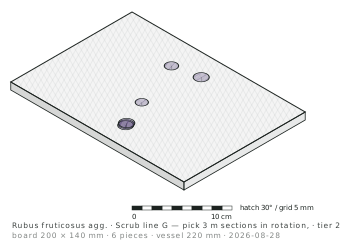
Work a hedge in sections rather than stripping it. Three metres picked today, three more in six days’ time, and so on down the line means you catch each patch at its peak instead of taking a mix of ripe and unripe from all of it.
What to do about the seeds
The seeds are the reason blackberry jam has a reputation for being gritty, and the answer depends on what you want. For a seedless jelly, cook 1 kg of fruit with 150 mL of water for 20 minutes, strain through a jelly bag overnight without pressing — pressing pushes seed fragments through — then use 450 g of sugar per 600 mL of juice. Yield drops by about a third, but the texture is flawless.
For jam, cook the fruit hard for 12 minutes first, then push it through a coarse sieve with the back of a ladle. This removes the majority of the seeds while keeping enough body that the set is still firm. Cost: about a third of your time for about a fifth of the annoyance.
A third route avoids the problem entirely: freeze the berries overnight, then shake them in a colander. The frozen pulp separates from the seeds cleanly, and the seeds fall through. It works well but loses the texture of whole fruit, so use it for sauces rather than for jam.
The shoots and the leaf
The spring shoot, peeled, is a genuinely good vegetable and the reason the plant is called bramble rather than just blackberry. Take the top 15 cm of a new cane while it is still flexible, strip the thorns by running it through a folded cloth, peel the fibrous outer layer, and simmer 10 minutes. It tastes faintly of green apple and cooks like a thin asparagus.
The leaf is the old tea: 2 g of dried leaf per 200 mL, steeped five minutes, is astringent and mildly tannic and was the standard mouth rinse in country medicine. Do not drink it in quantity, and pick leaves only from canes that are fruiting, not from the tips you are going to eat next year.
Identification note: Bramble fruit is safe and unmistakable, but the thorns are not the only hazard: the same hedges carry deadly nightshade (Atropa belladonna), whose single shiny black berry sits on a star-shaped green calyx rather than on the white core a blackberry leaves behind. Check the core.