WO-011 · work order · 2026-09-16
Pedunculate oak
Quercus robur
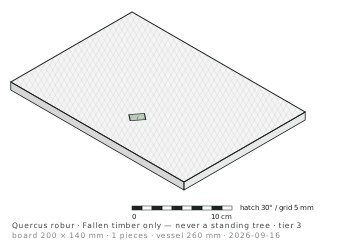
Oak is the one plant on this site where the harvest rule comes first: you take bark from timber that is already down, and you never fell or ring a standing tree for it. With that accepted, oak bark is a genuinely useful thing — the strongest tannin source in the European hedgerow, the base of leather tanning for two thousand years, and a flavouring for smoked fish, vinegar and bitters that nothing else quite replaces.
Bark
chilled 730 daysInner bark slips in whole sheets from fallen timber while the sap is up.
- 1
Drying — air-dry 5 days under weight
Mesh tray in a single loose layer ≤ 2 cm deep, 1–2 m/s airflow - 2
Lactic fermentation — 20 % of woodchip in a smoker
1 L wide-mouth jar, smaller jar as weight, 2 cm headspace, plate underneath - 3
Oil and vinegar infusion — 10 g : 500 mL vinegar, 21 days
Dark narrow-neck bottle; candy thermometer for the 60 °C ceiling
| Operation | Parameter · duration |
|---|---|
| Harvest cue | Inner bark slips in whole sheets from fallen timber while the sap is up. |
| Blanch | not required — used raw |
| De-bitter | None. Air-dry flat under weight 5 days; the astringency is the product. |
| Chilled | 730 days |
Seed
chilled 180 daysAcorns drop and the cap separates cleanly; discard any with a 2 mm round hole.
- 1
Blanching — leach 4–6 changes
28 cm wide stainless pan, spider, ice bath at 1:1 - 2
Drying — 50 °C, 8 h
Mesh tray in a single loose layer ≤ 2 cm deep, 1–2 m/s airflow
| Operation | Parameter · duration |
|---|---|
| Harvest cue | Acorns drop and the cap separates cleanly; discard any with a 2 mm round hole. |
| Blanch | 1200 s |
| De-bitter | Leach: cold water 2–4 days, or 4–6 changes of boiling water at 20 min each. |
| Chilled | 180 days |
Taking bark without killing a tree
The reason people strip bark from standing trees is that in late spring the bark slips: the cambium is dividing and the inner bark separates from the wood with almost no effort. That is also exactly why stripping a standing tree kills it — you have removed the tissue that carries sap. The rule is therefore absolute: bark comes from felled or storm-thrown timber, never from a living trunk.
From a fallen branch or a felled trunk, take the inner bark, not the outer. The outer layer is corky, grey and full of dirt and lichen; the inner bark is the pale tan layer between it and the wood, and it is where the tannins are. Peel it in strips, dry them flat under weight for five days, then store in a paper sack. Dried oak bark keeps two years with no loss of tannin.
The Spring peel should come off in whole sheets, like a stiff fabric. If it shreds into short fibres, the sap has already gone down and the tannin content is much lower — you can still use it, but you will need about half again as much.
Tannin, and the two things it is genuinely good for
Oak bark is about 8–12 % tannin by dry weight, mostly ellagitannins. That makes it powerfully astringent, which is why it is not a drink to have casually and why it has two clearly defined culinary uses.
The first is smoking. A handful of dried oak bark on the fire under a piece of hot-smoked trout or mackerel gives a clean, dry, slightly vanilla smoke that is quite different from woodchip — sharper and less sweet. Use it at about 20 % of the woodchip volume, no more, or the fish turns bitter.
The second is as a clarifying and bittering agent in vinegar and in home bitters. 10 g of dried bark steeped in 500 mL of cider vinegar for three weeks gives a dark, tannic vinegar that is excellent on oily fish and in a marinade for game. In bitters, 2 g per 500 mL is already a strong presence; go carefully, because oversteeped oak goes from pleasantly dry to mouth-puckering in about 48 hours.
Acorns, and the honest answer about leaching
Acorns are edible and nutritious — around 60 % carbohydrate, 6 % protein, 10 % fat — and they are also, raw, unpalatably bitter because of tannins at 5–8 % of the kernel weight. Every culture that has eaten them has had a leaching method, and all of them work; none of them is quick.
The cold method is the gentlest. Shell the acorns, grind them coarsely, tie the meal in a cloth and run cold water through it for two to four days, or leave the bag in a stream. Test by tasting a pinch: when the bitterness is gone, stop. This preserves the starch and gives a flour that bakes well, but it takes days.
The hot method is faster and destroys the starch, so the result is only good for porridge or as a thickener. Boil shelled, halved kernels in several changes of water, 20 minutes each, until the water stops going brown and the taste is neutral — typically four to six changes. It is worth doing once to understand the ingredient. It is not worth doing twice unless you have a lot of acorns and a lot of time.
A note on the species: pedunculate oak acorns are more tannic than those of holm oak or white oak, so if you have a choice, take the milder ones. Never eat acorns from a tree you cannot identify, and never eat them raw.
Identification note: Oak bark must come from felled or fallen timber, never from a standing tree — stripping live bark kills it. Acorns are toxic-adjacent when raw: they must be leached. Oak bark tea is not a casual drink, and it should not be taken by anyone on medication for blood pressure or diabetes.