WO-022 · work order · 2026-10-20
Hawthorn
Crataegus monogyna
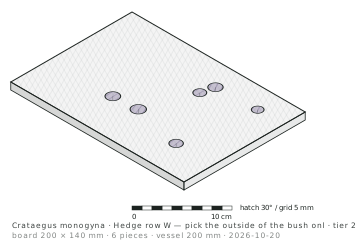
Hawthorn is the plant that gives the hedgerow its structure, and it gives three crops in one year: young leaves in April, flowers in May and haws in October. All three are edible, all three are distinct, and the haws are the one that stores the best. The name — haw — is an old word for a hedge, and the whole plant is essentially the definition of a boundary.
Fruit
chilled 14 daysDeep even red, flesh firm; flavour improves markedly after a frost.
- 1
Drying — leather at 55 °C, 8 h
Mesh tray in a single loose layer ≤ 2 cm deep, 1–2 m/s airflow - 2
Lactic fermentation — 3 % sugar, 10 days
1 L wide-mouth jar, smaller jar as weight, 2 cm headspace, plate underneath - 3
Oil and vinegar infusion — in brandy 1:2.5, 56 days
Dark narrow-neck bottle; candy thermometer for the 60 °C ceiling - 4
Candying and sugar preservation — jelly 450 g sugar : 600 mL juice
Jam thermometer to 110 °C, wire rack over a tray for 24–48 h of drying
| Operation | Parameter · duration |
|---|---|
| Harvest cue | Deep even red, flesh firm; flavour improves markedly after a frost. |
| Blanch | not required — used raw |
| De-bitter | None, but never crush or blend the stones — they carry a cyanogenic glycoside. |
| Chilled | 14 days |
Flower
chilled 1 daysMorning only, before the trimethylamine scent turns; dry the same day.
- 1
Drying — 35 °C, 3 h
Mesh tray in a single loose layer ≤ 2 cm deep, 1–2 m/s airflow - 2
Oil and vinegar infusion — 2 g per 200 mL at 80 °C
Dark narrow-neck bottle; candy thermometer for the 60 °C ceiling
| Operation | Parameter · duration |
|---|---|
| Harvest cue | Morning only, before the trimethylamine scent turns; dry the same day. |
| Blanch | not required — used raw |
| De-bitter | None. |
| Chilled | 1 days |
Leaf
chilled 1 daysPale newly broken leaves in April; two weeks at most.
| Operation | Parameter · duration |
|---|---|
| Harvest cue | Pale newly broken leaves in April; two weeks at most. |
| Blanch | not required — used raw |
| De-bitter | None; eat raw the same day. |
| Chilled | 1 days |
Haws, and the mealy problem
A haw is a small dark red fruit with a single large stone in the middle and a dry, mealy flesh around it. That flesh is not juicy and never will be; it is why hawthorn is best as a jelly, a ketchup or a fruit leather rather than as a pie filling, and why anyone expecting a cherry-like experience is disappointed.
The haws should be picked when they are a deep even red, usually from the last week of September, and the flavour improves markedly after a frost — the same frost that sweetens rosehips. If you have no frost, freeze them for 48 hours and the flesh will give up its flavour far more readily.
The stone is the processing issue. For jelly it does not matter — you simmer the whole haws, strain through a jelly bag overnight and the stones stay behind. For ketchup or leather you need to push the pulp through a sieve, which is slow but effective. Never put haws in a blender whole.
Ketchup, and the fruit that tastes of autumn
Hawthorn ketchup is the best use of the fruit and the one that convinces people who do not like foraged food. Simmer 500 g of haws in 300 mL of water with 150 mL of cider vinegar and 60 g of sugar for 40 minutes, push through a sieve, then return to the pan with 1 tsp of salt, a pinch of allspice and 20 mL of soy and reduce until it coats a spoon. It is dark, sharp, faintly sweet and it works on sausages, cold beef and cheese.
The same base, cooked down further and dried at 55 °C on a silicone sheet for eight hours, becomes a fruit leather with a texture somewhere between a wine gum and a slice of fruit cake. It keeps six months in a tin.
For jelly, the ratio is 450 g of sugar per 600 mL of juice, plus the juice of one lemon. Hawthorn is high in pectin and sets reliably; if anything, it sets too hard, which is why the lemon is worth adding for balance rather than for set.
The other thing worth making is hawthorn brandy: 200 g of haws pricked with a pin, 500 mL of brandy, 100 g of sugar, left eight weeks and strained. It is the traditional winter drink in much of rural Europe and it is very good.
The leaf and the flower, which are separate crops
Young hawthorn leaves in April, before the hedge hardens, are called bread and cheese in England, and the name is not ironic — they are mild, slightly nutty and quite pleasant raw. Take the pale, newly broken leaves only, and eat them on the spot or in a salad the same day. They are a two-week window at most.
The flowers, in mid-May, are the last of the three. They smell of something between almond and a slightly sweet fishiness, which sounds wrong and is in fact exactly what it is — the compound responsible is trimethylamine, the same one that makes old fish smell. On a warm morning the scent is lovely and by late afternoon it has turned, which is why you pick the flowers in the morning and dry them fast.
Dried hawthorn flower at 35 °C for three hours keeps its aroma for about six months. Two grams in 200 mL of 80 °C water is a mild, pleasant tea. Hawthorn preparations are widely sold for the heart; the evidence for mild benefit in heart failure is more interesting than for most herbal claims, but this is field information and not medical advice, and anyone with a heart condition should not self-treat.
Identification note: Haws, flowers and young leaves are all edible, but hawthorn is in the rose family and the seeds contain a small amount of cyanogenic glycoside — never crush or blend the stones. Hawthorn is also a mild cardioactive herb; anyone on heart or blood pressure medication should not take it medicinally.