WO-008 · work order · 2026-09-01
Dog rose
Rosa canina
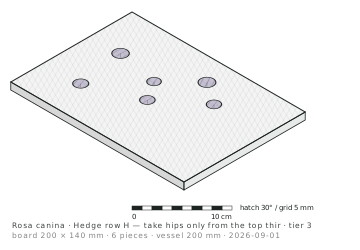
Rosehips are the highest-vitamin-C fruit in the British hedgerow, and also the most irritating to process. The irritation is not the thorns — it is the seeds. Each hip contains a cluster of hairy achenes, and those hairs are the base of the old itching powder joke and a genuine throat irritant. Everything about hip processing is really about keeping those hairs out of the finished product.
Fruit
chilled 21 daysHips give slightly under a thumbnail and the skin is glossy red with no black spot.
- 1
Drying — 55 °C, 10 h
Mesh tray in a single loose layer ≤ 2 cm deep, 1–2 m/s airflow - 2
Lactic fermentation — 3 % sugar, 10 days
1 L wide-mouth jar, smaller jar as weight, 2 cm headspace, plate underneath - 3
Oil and vinegar infusion — in brandy 1:4, 42 days
Dark narrow-neck bottle; candy thermometer for the 60 °C ceiling - 4
Candying and sugar preservation — syrup 450 g sugar : 600 mL juice
Jam thermometer to 110 °C, wire rack over a tray for 24–48 h of drying
| Operation | Parameter · duration |
|---|---|
| Harvest cue | Hips give slightly under a thumbnail and the skin is glossy red with no black spot. |
| Blanch | not required — used raw |
| De-bitter | Frost or 48 h freezing cuts the astringency; never blend whole, the hairs irritate the throat. |
| Chilled | 21 days |
Flower
chilled 1 daysPetals pull away cleanly and the green base stays behind — discard that base.
- 1
Drying — 35 °C, 3 h
Mesh tray in a single loose layer ≤ 2 cm deep, 1–2 m/s airflow - 2
Oil and vinegar infusion — fresh petals in water, 2 tsp : 200 mL
Dark narrow-neck bottle; candy thermometer for the 60 °C ceiling - 3
Candying and sugar preservation — rose sugar, 6 months
Jam thermometer to 110 °C, wire rack over a tray for 24–48 h of drying
| Operation | Parameter · duration |
|---|---|
| Harvest cue | Petals pull away cleanly and the green base stays behind — discard that base. |
| Blanch | not required — used raw |
| De-bitter | Remove the green base; it is the only bitter part. |
| Chilled | 1 days |
Frost, and the three ways to handle seeds
Hips sweeten and lose some of their astringency after the first hard frost, so the traditional advice is to wait. If the autumn is mild, pick them anyway in early November and freeze them for 48 hours, which does the same job: the cell walls rupture and the flesh gives up its juice far more easily.
For syrup, the seed problem is solved by not breaking the fruit. Simmer 500 g of whole hips with 700 mL of water for 20 minutes, then mash and strain through a double layer of muslin — no pressing, no whisking. The vitamin C survives because it is in the flesh, not the seed, and the hairs stay in the bag.
For jelly, use the same liquid and reduce it with 450 g of sugar per 600 mL. For a hip purée, you need to halve and de-seed each hip, which is genuinely tedious and only worth doing for a special-occasion dish: 1 kg of hips gives about 300 g of cleaned flesh and takes roughly forty minutes.
Vitamin C and heat, without the myth
Rosehips contain roughly 300–1200 mg of ascorbic acid per 100 g of fresh flesh, which is twenty to forty times the level in an orange. Ascorbic acid degrades with heat, but it degrades slower than the folk story suggests: at 100 °C in a covered pan for 20 minutes, you lose maybe a quarter to a third. That still leaves a syrup that is far richer in vitamin C than anything you can buy.
What destroys it much faster is oxygen and light. So: keep the pan covered, stir as little as possible, bottle in dark glass, and store the bottles in a cupboard rather than on a windowsill. A hip syrup kept that way holds its colour for a year and its vitamin C for about six months.
A caution that belongs with the recipe: rosehip syrup is a traditional children’s winter dose and it is also, if you use a lot of sugar, a fairly sweet one. It is a food, not a supplement, and it does not replace anything a doctor would prescribe.
Beyond syrup: hips in savoury and dried use
Dried and ground, hips become a tart, dusty powder that works as a sour seasoning on lamb, in a spice rub with cumin and paprika, or stirred into yogurt. Dry them whole at 55 °C for 10 hours, then grind and sieve out the fibres — the hairs come away with the fibre fraction, which is why you sieve rather than just grind.
The petals are a different crop entirely and the window is short: pick on a dry morning in late May, pull the petals, and discard the green base — it is bitter. Two teaspoons of fresh petals in 200 mL of hot water makes a delicate tea, or layer them with sugar for a rose sugar that keeps six months. Never pick the hips and the petals in the same year off the same bush.
Identification note: Rosehips are safe but the seed hairs are a serious throat irritant and the classic source of itching powder. Always strain through muslin rather than a metal sieve, and never blend hips whole.