WO-009 · work order · 2026-09-06
Hazel
Corylus avellana
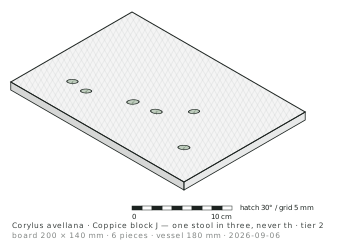
Hazelnuts are the one wild crop on this site where the competition is serious. Squirrels, dormice, jays and wood mice all take them, and they start three weeks before the nut is worth eating. The practical consequence is that you have to know the difference between a nut that is full and a nut that is merely brown, and you have to be willing to pick early enough to beat the mammals and dry the crop yourself.
Seed
chilled 365 daysHusk straw-coloured and the nut rattles inside it; kernel pale cream and snaps.
- 1
Drying — air-dry 2 weeks in shell
Mesh tray in a single loose layer ≤ 2 cm deep, 1–2 m/s airflow - 2
Oil and vinegar infusion — roasted, 1:5, 28 days
Dark narrow-neck bottle; candy thermometer for the 60 °C ceiling - 3
Candying and sugar preservation — praline, 160 °C 12 min then caramel
Jam thermometer to 110 °C, wire rack over a tray for 24–48 h of drying
| Operation | Parameter · duration |
|---|---|
| Harvest cue | Husk straw-coloured and the nut rattles inside it; kernel pale cream and snaps. |
| Blanch | not required — used raw |
| De-bitter | None. Two weeks of air-drying removes the astringency in the skin. |
| Chilled | 365 days |
Shoot
chilled 3 daysTop 10 cm of the year's growth, still folding when pinched.
- 1
Blanching — 30 s
28 cm wide stainless pan, spider, ice bath at 1:1 - 2
Salt-brine pickling — 2 % brine, 7 days
1 L wide-mouth jar, glass weight, 3 cm headspace - 3
Drying — 40 °C, 3 h
Mesh tray in a single loose layer ≤ 2 cm deep, 1–2 m/s airflow - 4
Lactic fermentation — 2 % salt, 7 days
1 L wide-mouth jar, smaller jar as weight, 2 cm headspace, plate underneath
| Operation | Parameter · duration |
|---|---|
| Harvest cue | Top 10 cm of the year's growth, still folding when pinched. |
| Blanch | 30 s |
| De-bitter | Blanch 30 s; no further treatment. |
| Chilled | 3 days |
The husk test, and why the squirrel wins
A hazelnut in its green husk is nowhere near ready. The husk turns from green through yellow to a straw colour, and the nut is ready at the point where the husk is straw-coloured and the nut rattles loosely inside it. If you open a nut and the kernel is white and rubbery, it is three weeks off; if it is pale cream and snaps, it is right.
Because squirrels work the same three weeks, the strategy is to pick at the straw-husk point and finish ripening off the tree. Spread the nuts in a single layer in a dry, airy room for two weeks. The kernel loses about 30 % of its weight in that time, the skin stops being astringent, and the flavour concentrates. Nuts left to drop and gathered off the ground are usually already holed — look for a neat 2 mm round hole, which is the exit of a weevil grub.
Ripe nuts sink in water; the ones that float are hollow or grub-damaged and should be discarded immediately, because one infested nut will spread mould through a jar.
Drying, storing, and rancidity
Hazelnuts are roughly 60 % fat and go rancid in about four months at room temperature. Stored properly they keep twelve months with little change. The correct sequence is: two weeks air-drying in the shell, then a week in a sealed jar with a sachet of silica gel, then either freezing in the shell or shelling and refrigerating in a dark jar.
The test for rancidity is smell before taste — a nut that is going will smell of crayon or old paint. Once that note is there, no amount of roasting brings it back, and the oils are already oxidised. If you have more nuts than you can use in four months, freeze them; hazelnuts freeze perfectly and shell straight from frozen.
Roasting is what makes the flavour: 160 °C for 12 minutes on a dry tray, then rub the nuts in a cloth while still warm and the papery skins come off. Roasted and skinned nuts are the base for the home version of a praline paste, and they keep only six weeks.
Stool management, which is the real craft
A hazel stool is a permanent thing, and how you cut it determines the crop for the next five years. The rule used by coppice workers is never to cut a stool to the ground more often than every seven to ten years, and even then to leave one or two standards per stool to keep it fed.
The reason is that nuts form on one-year-old wood produced by a stool that is at least four years from its last cut. A stool cut every three years produces wonderful straight rods for hurdles and no nuts at all. If you want nuts, you leave the stool alone and only take the tips in spring for the shoots, which does not disturb next year’s wood.
Never pick a stool clean in any case. Leave at least a third of the nuts on the bush — they are the winter food supply for dormice, a protected species in the UK, and hazel coppice is one of their last habitats.
Identification note: Hazelnuts are safe and, in the husk, unmistakable. The only real hazard is aflatoxin from mouldy stored nuts — discard anything with black or grey patches or a musty smell rather than picking the bad ones out.