WO-019 · work order · 2026-10-11
Red clover
Trifolium pratense
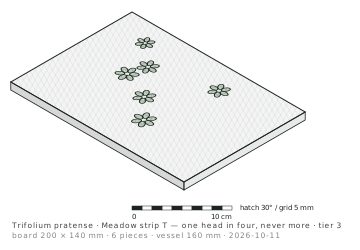
Red clover is one of the very few wild flowers that is worth eating for its sweetness rather than its bitterness. The florets pull out of the head in a single motion and each one has a bead of nectar at the base, which is why red clover honey is one of the great honeys and why the fresh flower is genuinely nice to chew. Everything else about the plant follows from that sweetness.
Flower
chilled 2 daysDeep fresh pink with no brown florets at the base; florets pull away as intact tubes.
- 1
Drying — 35 °C, 3 h
Mesh tray in a single loose layer ≤ 2 cm deep, 1–2 m/s airflow - 2
Lactic fermentation — in mead, 14 days
1 L wide-mouth jar, smaller jar as weight, 2 cm headspace, plate underneath - 3
Oil and vinegar infusion — 100 g : 500 mL wine vinegar, 14 days
Dark narrow-neck bottle; candy thermometer for the 60 °C ceiling - 4
Candying and sugar preservation — syrup in honey, 200 g : 300 g, 21 days
Jam thermometer to 110 °C, wire rack over a tray for 24–48 h of drying
| Operation | Parameter · duration |
|---|---|
| Harvest cue | Deep fresh pink with no brown florets at the base; florets pull away as intact tubes. |
| Blanch | not required — used raw |
| De-bitter | None. The nectar is the point — do not wash the heads. |
| Chilled | 2 days |
Leaf
chilled 3 daysYoung leaves at the top of a flowering stem, in May and June only.
- 1
Blanching — 15 s
28 cm wide stainless pan, spider, ice bath at 1:1 - 2
Drying — 40 °C, 3 h
Mesh tray in a single loose layer ≤ 2 cm deep, 1–2 m/s airflow - 3
Lactic fermentation — 2 % salt, 5 days
1 L wide-mouth jar, smaller jar as weight, 2 cm headspace, plate underneath
| Operation | Parameter · duration |
|---|---|
| Harvest cue | Young leaves at the top of a flowering stem, in May and June only. |
| Blanch | 15 s |
| De-bitter | None; use no more than a handful, clover leaf is heavy and soapy in quantity. |
| Chilled | 3 days |
Colour, and the head that is past it
The head should be a deep, fresh pink-red with no brown florets at the base. The moment the lowest florets in the head start to brown, the whole head has begun to dry and it will taste of hay and dust rather than nectar. Work the meadow every three or four days through the season rather than making one big visit, and you will catch each head at its peak.
Pull a head apart with two fingers and the individual florets should come away easily and stay tubular. If they crumble instead, the head is too old. Take the whole head with a short piece of stem and put it straight into a flat basket — the heads sweat and brown in a bag within an hour.
Leave at least three heads in four. Red clover is a crucial bumblebee plant and the long-tongued species that depend on it are in decline; a meadow that has been picked clean of clover has been picked clean of its pollinators.
The uses that are actually worth it
The first is clover honey, which you cannot make, but you can make the next best thing: a clover syrup. Pack 200 g of fresh florets into a jar, cover with 300 g of mild honey or 250 g of sugar syrup at 65 °Bx, and leave three weeks in a warm place. Strain and you have a deeply floral, pink-tinted honey that is better than most of what is sold as clover honey.
The second is a clover vinegar, which is the most versatile output. 100 g of fresh florets into 500 mL of white wine vinegar for two weeks gives a soft, pink, faintly sweet vinegar that is excellent on a tomato salad and in a dressing for a bitter leaf salad. It also makes a striking colour — a pale rose that holds for months.
The third is the leaf, which is the most underused part. Young clover leaves from the top of a flowering stem are mild and slightly bean-like, and they are good chopped into a salad or stirred into a soup at the end. Do not use more than a handful: clover leaf in quantity is heavy and slightly soapy.
A caution about hormones, stated plainly
Red clover contains isoflavones — formononetin, biochanin A and genistein — which are phytoestrogens and bind weakly to oestrogen receptors. This is real and measurable, and it is the reason red clover supplements are sold. In a food context, the amounts are small: eating a dozen flower heads in a salad or using clover syrup is not a meaningful hormonal dose.
The situation changes with concentrated extracts and with regular daily supplementation. Anyone with an oestrogen-sensitive condition, anyone on tamoxifen or hormone therapy, and anyone pregnant should treat red clover as a supplement rather than a food and speak to a clinician rather than a foraging guide. This is field information, not medical advice — the same line this site takes on meadowsweet and on oak bark.
Identification note: Red clover contains phytoestrogenic isoflavones. As a food the amount is small; do not treat concentrated extracts as a food, and consult a clinician if you are on hormone therapy or pregnant.