WO-020 · work order · 2026-10-14
Borage
Borago officinalis
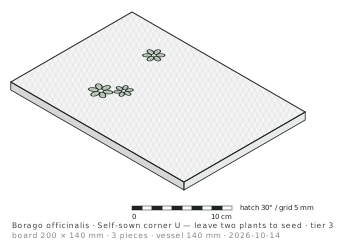
Borage is the only plant on this site that most people already grow on purpose. The flowers are that improbable clear blue, they taste faintly of cucumber, and they are one of the few things that can be picked, carried inside and put straight onto a dish without any processing at all. The leaf is a different proposition and only worth it for about three weeks a year.
Flower
chilled 2 daysFully open and dry in the cool of the morning; lift rather than pull.
- 1
Blanching — never
28 cm wide stainless pan, spider, ice bath at 1:1 - 2
Oil and vinegar infusion — frozen in ice cubes, 2 months
Dark narrow-neck bottle; candy thermometer for the 60 °C ceiling - 3
Candying and sugar preservation — candied on a cake, 1 day
Jam thermometer to 110 °C, wire rack over a tray for 24–48 h of drying
| Operation | Parameter · duration |
|---|---|
| Harvest cue | Fully open and dry in the cool of the morning; lift rather than pull. |
| Blanch | not required — used raw |
| De-bitter | None. Never cook — the cucumber note is destroyed by heat. |
| Chilled | 2 days |
Leaf
chilled 2 daysFrom a plant that has not yet opened its first flower.
- 1
Blanching — 30 s, then rub off bristles
28 cm wide stainless pan, spider, ice bath at 1:1 - 2
Salt-brine pickling — 2.5 % brine, 7 days
1 L wide-mouth jar, glass weight, 3 cm headspace - 3
Lactic fermentation — 2 % salt, 5 days
1 L wide-mouth jar, smaller jar as weight, 2 cm headspace, plate underneath
| Operation | Parameter · duration |
|---|---|
| Harvest cue | From a plant that has not yet opened its first flower. |
| Blanch | 30 s |
| De-bitter | Blanch 30 s then rub between two cloths to strip the bristles. |
| Chilled | 2 days |
The flowers, which need almost nothing
Pick in the cool of the morning, when the flowers are fully open and dry. They bruise to a grey-blue within minutes if they are handled, so lift them off the plant rather than pulling, and carry them in a single layer in a flat box. In a bag they will be compost by the time you get home.
They need no processing at all. Drop them into a Pimm’s or a gin and tonic, scatter them over a salad, freeze them in ice cubes for the visual effect, or candy them for a cake. The cucumber note is faint but real, and it disappears entirely in hot food — borage flowers are a cold-kitchen ingredient and putting them in a hot pan wastes them.
If you want them for a drink later in the week, freeze them in a single layer on a tray and then bag them. Frozen borage flowers keep two months and can go straight from the freezer into a glass without defrosting.
The leaf: hairy, and worth exactly three weeks
A borage leaf is covered in stiff white bristles and eating one raw is an unpleasant experience — the hairs catch in the throat. That is not a safety issue but it is a strong argument for cooking them, and cooking works: the bristles soften completely in about 30 seconds.
Young leaves from a plant that has not yet flowered are mild and distinctly cucumber-flavoured, and they are the traditional ingredient in a borage and sorrel soup or chopped into a cream cheese. Once the plant starts to flower, the leaves turn bitter and the bristles get worse. That gives you roughly the three weeks in late May and early June before the first flower opens.
A useful trick if you want the flavour without the bristles: blanch 30 seconds, then rub the leaves between two cloths. The bristles come away with the cloth and you are left with a soft, mild leaf that can be used raw.
The seed oil, and a warning that belongs here
Borage seed oil is sold as a source of gamma-linolenic acid and is a legitimate commercial product. It is also extracted and concentrated, and it is not the same thing as eating the plant. The leaf and flower contain small amounts of pyrrolizidine alkaloids, which are the reason borage is not recommended in quantity over long periods, and why it is not recommended at all for pregnant or breastfeeding women or for anyone with liver disease.
In practice the levels in leaf and flower are low and the amounts eaten are small — a few flowers in a glass, a soup with a handful of leaf — and that is the intended use. What is not advisable is a daily borage-leaf smoothie as a health routine, which is the pattern that shows up in the case reports.
The plant itself is impossible to confuse with anything dangerous: the bristly stems, the nodding star flowers and the clear blue colour are unmistakable. The caution is about quantity, not identification.
Identification note: Borage leaf and flower contain small amounts of pyrrolizidine alkaloids and are not recommended in quantity or long-term, and not at all during pregnancy, breastfeeding, or with liver disease. It is also a mild diuretic.